
How Can We Rein In Data Centers?
Pat Miller is co-chair of the Sierra Club's Building Electrification Committee

Some people are saying we need a moratorium on new data centers because of the problems they are causing, such as air and noise pollution, excessive electricity and water use, and dramatically increasing electricity prices. “Data centers were responsible for 63% of capacity price increases in the 2024 PJM auction,” according to Angela E. Juneau’s Jan 2026 research paper, Data Centers and New Jersey’s Energy Crisis. (PJM is New Jersey’s and 12 neighboring states’ Regional Transmission Organization.) We certainly need to have some rules and regulations in place around them. And fast! Or we can expect more of the same.
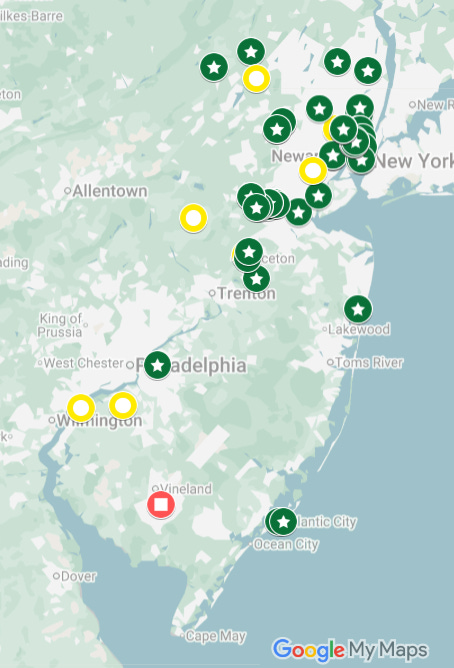
There are more than 80 data centers in NJ, as shown in the following map and more are planned.
Sierra Club Data Center Policies, 2026: Mitigating the Impacts of Data Centers on the Environment, Communities, and Affordability lays out a set of policies for doing this. It considers four major categories of guardrails:
Protect Customers, by having data centers pay their fair share, such as with Large Load Tariffs, special rate classes, and prevention of cross subsidies;
Clean Energy Comes First would require each data center to bring their own clean energy, preferably onsite, or at least to comply with NJ’s Renewable Portfolio Standard, whether by building renewables onsite or elsewhere or buying Renewable Energy Credits;
Fair Rules for Tech (and all) means not offering data centers subsidies on local or state taxes or utility rates; and
Protect Public Health with cumulative impacts and air permit requirements or by requiring onsite battery backup for short duration grid outages or to offset the data center’s peak load requirement, rather than using backup diesel generators.
In addition to legislation or regulations aimed directly at data centers, New Jersey and all the PJM states are trying to ramp up our clean energy grid supply and modernize our grid to handle that larger supply. These measures are desperately needed to handle the current and growing levels of electricity demand by data centers and to throttle down the price increases for all customers. The loss of our initial installations of offshore wind has been a terrible blow to our needed grid supply and reliability. To make it worse, many applications to interconnect new renewable energy projects have been sidetracked by PJM in favor of more fossil fuel (primarily gas) electricity generation, which will take years longer to build and be brought online.
We and our allies are advocating on many fronts. We are all aware of the many legal actions across the country to reverse (most successfully) the federal administration’s roadblocks to renewable energy.
In January 2026, the governors of the 13 PJM states signed an agreement with the Federal Secretaries of Energy and Interior to:
accelerate the speed at which new power comes online,
ensure data centers cover their share of the costs of any new resources, and
stem the increase in auction prices to bring affordability to the PJM region.
Also in January, Governor Sherrill issued Executive Orders 1 and 2 that stipulate many steps (with deadlines) the Board of Public Utilities and other state agencies must take toward the goals of generating more grid-scale and community solar and grid-scale battery storage. The orders also require them to develop Demand Response (DR) programs and Distributed Energy Resources Management (DERM) systems that would provide and monitor energy to the grid from thousands or millions of customers’ devices such as home or electric vehicle (EV) batteries, rooftop solar, smart meters and thermostats (to reduce space heating/cooling or water heating loads), or other devices as needed when the grid is approaching its peak load, via a network of Virtual Power Plants (VPP). This would reduce the peak energy load, enabling the grid to more reliably handle a larger demand.
Planning and project awards are underway for the various ordered actions and are already producing results. Furthermore, the expansion of the grid to serve data centers will also provide the supply needed for an increase in heat pumps and EVs. And VPP, along with upgrading the grid (and its business model) for two-way flow of electricity, plus the falling price of solar and batteries mean that much of that supply will be through renewables.
On the legislative front are at least three sets of bills before the legislature to manage data centers:
S680/A1170 for data centers to bring their own clean energy, prioritizing onsite;
S731/A796 requiring special Large Load Tariffs with front-loaded costs for data centers;
S3379/A4096 for transparency and reporting of electricity and water use.
There is also a siting-related bill S1857/A177 stipulating that data centers be built away from homes, make efficient use of water, and not be situated in protected areas such as wetlands, forests or farms.
More legislation is needed. We still need to rein in the tax incentives, as has been done in Michigan, Minnesota, and Illinois. We need noise and cumulative emissions mitigation. We are fighting the good, but challenging, fight.
This is a free newsletter. If asked to pledge support, say “No thanks!”