
Virtual Power Plants: Lowering Your Electric Bill AND Helping The Power Grid
You can be an energy entrepreneur...soon!

Across the country, consumers have seen a dramatic rise in electricity prices driven by the steep increase in power demand, mostly from data centers. Data centers increase energy usage but more importantly, they increase the peak demand for energy on very hot days. One of the solutions being developed by states, including the New Jersey Board of Public Utilities (BPU), is allowing customers or aggregated groups of customers to flexibly manage their energy usage and even to sell power back to the grid. Indeed, Gov. Sherrill’s Executive Order #2 on her first day requires the BPU to start the development of the rules for power purchase between utilities and third party aggregators of customers within 180 days. There is also NJ Senate Bill S3399, requiring the utilities to establish a program to reduce peak demand.
What are VPPs and Why Are They Needed
For New Jersey, the cost of electricity is determined by periodic energy and capacity auctions, where suppliers bid the quantity of energy that they can supply and its cost. (A more detailed explanation is available in another article on this site.) The Regional Transmission Organization (RTO) is a supervising organization of local utilities (PJM, for NJ customers). PJM purchases the available energy and capacity in price order from cheapest to the more expensive, until they have satisfied the forecast demand. If they are able to reduce the peak energy usage, the RTO does not have to purchase the most expensive energy. The good news is that peak energy usage usually occurs for only a few hours in the mid-afternoon to early evening, when both business and residential customers are using the most energy. If there was a way to supply additional energy to the grid during that peak, or cut the energy demand to lower the peak, total energy cost would be reduced. Virtual Power Plants (VPPs) can do both of those. VPPs can also control energy costs by using local customers to supply or reduce local energy needs, avoiding costly upgrades to the distribution and transmission lines and substations.
Managing energy supply and demand is sorely needed. More than 140 million people in 40 states dealt with calls to conserve power and avoid blackouts in 2022. VPPs have been proven to work - solar installations distributed across the customer base reduced peak load in New England by almost 1.5 GW, the equivalent of a large power plant, says an ISO-NE 2023 report.
How Do VPPs Work?
For many years, there have been utility programs that gave participants reduced rates in exchange for allowing the utilities one-way control of their equipment to reduce their energy demands, i.e. lower thermostats, raise air conditioning setpoints, or cut power to factories. Nowadays, smarter technologies (interoperability standards, smart thermostats & inverters, sophisticated resource monitoring software) have facilitated two-way information exchange between the customer and the utility. There has also been huge growth in the number of customers who generate their own power with solar installations and who may store it with batteries. Perhaps they have an EV or power wall whose large power capacity could be shared with the grid, or whose charging could be postponed until a time with less demand on the grid, e.g. overnight. These changes mean that large numbers of individual customers (or managed aggregations of customers) are incentivized to become a set of tiny distributed power plants that the grid could use when needed. Each customer or aggregation of customers that sells power back to the grid or reduces demand on the grid, when requested by the utility, is a Virtual Power Plant (VPP).
There are advantages to VPPs for both the utility and its customers. Individual customers have the economic incentive to build solar and battery installations themselves, meaning that the utility can leverage private capital and does not need to plan, site, permit, invest and build as many centralized plants. Building small individual installations can take place very quickly. Customers receive a better ROI on investments that they may have made anyway in energy efficient or smart appliances that can reduce demand, or solar, batteries and EVs.
There are two major issues impeding the development of VPPs. The first is that the power grid has basically been designed for one-way flow of power from utility to customer and it needs to be adapted to power also flowing back from VPP to the utility. The second is a policy issue addressing payments for energy, which were also only one-way, to the utility. The proper structure of payments to the VPP must be worked out.
Legislation/Policies for VPPs
According to Canary Media,
As of last year, 34 states have programs that call on utilities to use smart thermostats and water heaters, batteries and EV chargers, and energy management systems at businesses and factories…A dozen states are considering legislation this year that could launch or expand VPPs, including … New Jersey, and Pennsylvania.
The Federal Energy Regulatory Commission issued “FERC Order 2222” in 2020, requiring that RTOs and utilities allow small distributed energy resource customers to participate in the energy market through aggregation into larger units. Market price increases for energy are increasing the urgency and speed of its implementation.
The Business of Aggregation
SunRun’s Senior Director of Public Policy, Thad Culley, recently spoke with the Building Electrification Committee (recording of the webinar is available here;), stating that SunRun is actively pursuing the aggregation business, along with other companies such as Tesla. SunRun is the national leader in residential solar and battery installation, installing the equivalent of one nuclear plant’s worth of capacity every year.
SunRun’s argument in favor of VPPs is that they bring value both to the electric grid and the customer. With the ability to spread requests over a large number of customers participating as a block, SunRun is able to supply reliable power while guaranteeing individual customers flexibility about how or whether they want to participate.. Tesla Powerwalls have a special “storm watch feature” where users can opt out of supplying power during a major storm where they might need the battery themselves.
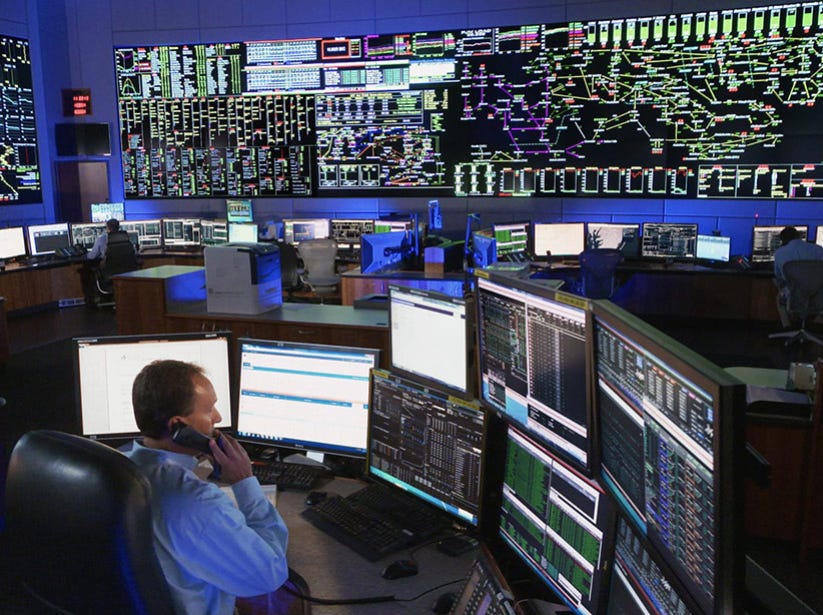
An aggregator’s value to the utility is that they reliably guarantee delivery of a specified amount of power, while managing all the details of customer communication and controls with custom software. You can see from the photo of PJM’s control room that controlling the grid is already complex, without the addition of many individual small suppliers.
SunRun points out that their experience shows that customers who are paid for supplying energy, at a time that coincides with the actual times of grid need, participate at a much higher rate than those that merely have time-of-use (TOU) differential energy prices that reflect averaged seasonal prices.
There have been several notable successes. Last year, SunRun and Tesla ran a trial in California, where their more than 70K customers were able to generate enough extra power to the grid (670 MW), to equal the contribution of an entire power plant! Also, SunRun, Tesla and other aggregators prevented rolling blackouts in Puerto Rico last summer, according to Utility Dive.
Conclusion
VPPs and Demand Reduction programs can reduce the demand on the power grid and supply additional energy to the grid, helping to alleviate price increases. We look forward to the BPU’s response to Gov. Sherrill’s Executive Order #2, creating effective VPP pilot programs. VPPs are a private benefit shared with the public for fair compensation. They can be built quickly, and have tremendous flexibility. Participate in a VPP when you are able and become an energy entrepreneur and energy hero yourself!
This is a free newsletter. If you are asked to pledge, just say “No, thanks!”